
Archive
MIGRATING WATERFOWL OF LAKE SCUGOG
Leave a CommentNEWS AT OCTOBER, 2020
“Lake Scugog is a very important staging area for waterfowl in both the spring and fall as they return from their wintering or breeding grounds up north. Migration consumes a lot of energy, so a safe haven with adequate food resources is essential. Many species will linger in the open bays and more vegetated wetlands, finding food and avoiding predators. Birds can be present for days or weeks depending on the species and the season.

Look for the puddle ducks (e.g. Mallards, Black Duck, Pintail, Gadwall, Green and Blue-winged Teal, Wigeon and Wood Ducks) in the shallower marshes, while diving ducks (e.g. Scaup, Redhead, Ring-necked Duck, Bufflehead, Mergansers and Golden-eye) prefer the open water.
The reason has a lot to do with how they feed. The puddle ducks, or dabblers, as they are called, feed by tipping up and grabbing small invertebrates or vegetation just below the surface. Diving ducks dive under water to find prey in deeper habitats. In the spring, the ducks start to return as soon as the ice leaves and will stay well into May to feed and rest before heading north to central and northern Ontario to breed. Most ducks start returning in October on their southbound journey and will often stay until the lake freezes over. A few species such as Blue-winged Teal, Hooded Mergansers and Wood Ducks breed locally and can offer delightful encounters all summer long!” from Geoff Carpentier, Avocet Nature Services.
For more information on how to identify what you might be seeing check out: https://www.ducks.ca/species/

We will be doing a bigger story on Wood ducks and Hooded Mergansers later on in the season.
In the meantime: Watch for Great egrets seen many times to the north in marshes on the north end of Lake Scugog. They are not just albino Blue Herons. See: https://www.simcoe.com/opinion-story/8635771-ontario-sees-wave-of-large-wading-birds/ for why we may be seeing more of these beautiful birds.
WINNERS OF OUR PHOTO CONTESTS TO DATE, Oct. 10, 2020
Leave a CommentFIRST PHOTO CONTEST, ‘SUNSET OR SUNRISE OVER LAKE SCUGOG’ : Rowena Garcia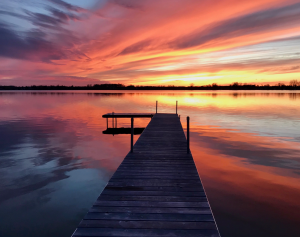 submitted this amazing photo of our beloved Lake Scugog sunsets. Congratulations Rowena.

WINNER OF OUR SECOND PHOTO CONTEST: ‘FUN ON LAKE SCUGOG’ – Closed September 15, 2020 — Lindsay Coutts submitted this great photo of the joys of summer for young people, innocence taking advantage of the last rays of sun to enjoy friends and water.
Ice safety
Leave a CommentSo important, but better still — stay off until the ice is really thick! Know the depth and the currents and springs that might make it thinner in spots.

Stormwater Management
Leave a CommentKawartha Conservation
Kawartha Conservation prepares and publishes a variety of lake and environmental management plans to provide a scientific approach to protecting and managing the environment over the short and long terms. These plans involve detailed field inventories and water quality and quantity studies to identify natural features and factors affecting their health.
Unmitigated stormwater’s impact

The lake’s ecosystem is primarily driven and stressed by human influences like stormwater runoff, which leads to high nutrient inputs, sedimentation, and overabundant aquatic vegetation, which all have harmful effects on the navigational, recreational and aesthetic qualities for residents around the lake.
Stormwater management is necessary to improve water quality. Stormwater carries contaminants like hydrocarbons, metals, oils, nutrients and it’s very high in suspended solids, and which lead to sedimentation.
Stormwater runoff enters Lake Scugog through three large-volume outlets, and was identified as major issue facing the lake’s water quality, by the Lake Scugog Environmental Management Plan prepared by Kawartha Conservation in 2010. Other factors include reduced biodiversity, excess nutrients, sedimentation, excess plant growth, algae blooms and invasive species.
Once stormwater reaches the lake, it cannot be treated.
Lake Scugog Enhancement
Kawartha Conservation’s Port Perry Stormwater Study (2013) identified lacking stormwater controls and a need to mitigate stormwater before it enters the lake. This observation became an impetus for the Lake Scugog Enhancement Project (LSEP).
As part of the LSEP, after stormwater is treated by the oil and grit separators en route to Lake Scugog, it will be deposited into a large engineered wetland that will naturally filter further pollutants from stormwater runoff before it reaches the lake.
Oil and Grit Separators
Oil and grit separators will be installed as a mitigation strategy and enhancement to the Lake Scugog Enhancement Project. They will be installed at specific treatment locations in the stormwater outlets to capture sediment and silt, which contain contaminants like hydrocarbons, metals and oils, and prevent them from reaching the engineered wetland.
These separators help reduce the total load of suspended solids (sediment/silt) that stormwater inputs into Lake Scugog. The engineered wetland will be located where the largest sediment input loads enter Lake Scugog, at the Baagwating and Casimir stormwater outlets.
Starry Stonewort:
Leave a Comment
November 9, 2018: Before the Scugog Lake Stewards determined that the new invasive alga starry stonewort had arrived and was taking over, lakes in Wisconsin and MIchigan were struggling with it. For an up to date report on what they have found and the problems that this new alga presents see: https://cdn.cloud1.cemah.net/wp-content/uploads/sites/63/2018/10/Starry-Stonewort-Invasive-Species-Field-Report-Fall-2018.pdf
Lake Stewards’ latest newsletter
Leave a Comment
YOU ARE PERSONALLY INVITED
and we hope to see you there!
A project of Scugog Township
in partnership with Kawartha Conservation and Scugog Lake Stewards Inc.
www.lakescugogenhancement.caFor further details please view the Notice attached and available at http://www.scugog.ca/en/township-office/resources/Notice-of-Public-Open-House—Dec-5-2017.pdf on the Township of Scugog’s website. If you have questions or require additional information please contact Carol Coleman at 905-985-7346 x149 or ccoleman@scugog.ca or Ian Dobrindt at 289-453-2014 or ian.dobrindt@ghd.com.
Other work of the Stewards ….RESEARCH
Our team: Dr. Jenny Korosi (Chair of research), Dr. Josh Theinpont (Project Manager), Dr. Ron Porter, Dr. Bill Eull, with Dr. Andrea Kirkwood, U.O.I.T., Tyler Harrow-Lyle, U.O.I.T. and near shore research citizen scientists with Debbie Balika, Water Quality Specialist of Kawartha Conservation.
With funding from the Ontario Trillium Foundation (OTF) this team has just completed a successful summer of research, with additional through the ice research to come this year. This builds on research already completed by Kawartha Conservation for the 2010 Lake Management Plan and two previous years of research by the Stewards and U.O.I.T. This has resulted in excellent and building data that we hope will guide lake management in the future.Research Team from L. to R. – J. Theinpont, J. Korosi, R. Porter, A. Kirkwood and T. Harrow-Lyle
EDUCATIONAL VIDEOS
As part of the grant received from OTF, we were able to produce 18 short videos to help the public understand the lake. These videos, listed at the end of this report, are being posted one per week, on Facebook and Twitter on the Lake Stewards’ and Lake Scugog Enhancement websites with a huge positive response. Beyond these social media outlets we hope to see them used in a wide range of public venues. We heartily suggest that you check them out at: video.https://www.youtube.com/channel/UCBwJ9rF6toXrKhReQ8fzT9ATitles of the videos:
- Lake Scugog Study Overview 2017
- Lake Scugog – What is Natural
- Near Shore – What we don`t know yet
- Lake Scugog Citizen Science
- Lake Scugog – Floating algae
- KCA – Bluescaping
- KCA – Blue Canoe Program
- Lake Scugog – Weeds aren`t so bad
- Weeds in the lake – Also known as macrophytes
- Diversity of Lake Scugog
- Lake Scugog – Climate and impact
- KCA – Near shore farmland
- Zebra mussels – Macroinvertebrates
- Is Scugog a clean lake?
- Lake Scugog’s connection to the Trent Severn Waterway
- Pine Point — shoreline naturalization
Many thanks to Jenn Sunnerton of MOKO Media for their work.
RESEARCH SHARING AMONG SCIENCE COMMUNITYThe Stewards are hosting a Lake Scugog Science Roundtable in late November. This will be an information and discussion session about the findings of this year’s and past Lake Stewards’ research about Lake Scugog. This is with the aim of adding to our combined knowledge and to share information for greater understanding. Researchers and scientists from U.O.I.T., Trent U., York U., U. of Ottawa, Kawartha Conservation, the Ontario Ministry of Natural Resources and Forestry, Fisheries and Oceans Canada, the Ontario Federation of Anglers and Hunters, Kawartha Lake Stewards and of course the Scugog Lake Stewards will be discussing trends not only in our lake but in all the Kawartha lakes. The Ontario Trillium Foundation is underwriting the cost and that of two additional sessions in future years.
WALLEYE SPAWNING BED REMEDIATIONThe Lake Stewards, with the Ontario Federation of Anglers and Hunters (OFAH), Ontario Invading Species and the Ontario Ministry of Natural Resources and Forestry (OMNRF) are looking at specific ways to remediate existing areas of known walleye spawning. This is still in the planning stage but hopefully some action will take place in the spring of 2018.
INVASIVE SPECIES CLEAN/DRAIN/DRY SIGN
The Scugog Lake Stewards obtained funding from the Federation of Ontario Cottagers’ Associations (FOCA) to develop a suitable sign for placement at the municipal boat launch in Port Perry to encourage boat cleaning before and after boating in Lake Scugog. It is hoped that funding will be received to place signs at other launches around the lake. It was developed with editorial input from FOCA, Kawartha Conservation, OFAH and Ontario Invading Species as well as Scugog Township. It is being printed at the moment for installation next spring.
November 20, 2017A special note to all members and friends of the Scugog Lake StewardsThis has been an exceedingly busy year for the Stewards. Yet there have been so many times when when we would have dearly liked to send you a newsletter with our information, but we always seemed to be waiting for something to finalize, — whether that be testing, or stages of completion of the Lake Scugog Enhancement Project, or year end results for our research, or approvals by partners. We hope that you have come along with us week by week following our day to day posts on Facebook and now on Twitter.
Your donations to the Lake Stewards through memberships pays our required expenses such as insurance, audit fees, accounting, website fees, hall rentals and so much more. Donations directed to either the Lake Scugog Enhancement Project or to Research are sequestered in separate accounts.
The best way to renew your membership is through our website (www.scugoglakestewards.com) and Canada Helps which will send you an automatic and immediate receipt. You may also renew by sending your cheque to Scugog Lake Stewards, P. O. Box 1282, 84 Water Street, Port Perry, On L9L 1A0. Specific donations to either the Enhancement Project or to our Research can be made the same ways, but please indicate the account you would like the funds to be accredited to.
2018 promises to be an even bigger year for us, and we hope that you will come along with us in our work by purchasing your new membership.
Barbara Karthein
President 2017
Click here to follow us on Facebook.
Copyright © 2017 Scugog Lake Stewards Inc., All rights reserved.
You are receiving this email because you are a member, or signed up and attended one of our events.
Our mailing address is:Scugog Lake Stewards Inc.
237 Queen Street, P. O. Box 1282Port Perry, ON L9L 1B9
Canada


Understanding toxic blue-green algae blooms
Leave a CommentLake Scugog has recently been identified by the MOECC as having a low level toxic algae bloom in the area off Kinsmen’s beach and the snowmobile ramp in Port Perry Bay. Specific conditions this year and a high existing level of nutrients in the lake have made it susceptible to the possibility of blooms of blue-green algae or cyanobacteria, which have the possibility of producing toxins or microcystins which can be harmful to various forms of life including humans. These blooms will appear as a blue-green paint spill on the surface of the water, or as an appearance like pea-soup in the water. Wave action may bring these blooms to the shoreline in bands of toxic sludge. Please send photos of any questionable occurrances to info@scugoglakestewards.com in complete confidence for early judgement and possible action.
This is a very peculiar year for the environment and the lake.
Check this site for further information: United States Environmental Protection Agency reports on blue-green algae. https://www.epa.gov/nutrient-policy-data/cyanobacteriacyanotoxins
What are some causes of cyanobacterial blooms?
-
light availability
-
water temperature
-
alteration of water flow
-
vertical mixing
-
pH changes
-
nutrient loading (both nitrogen and phosphorus)
-
trace metals
As a result of the interplay of these factors, there may be large temporal fluctuations in the levels of cyanobacteria and their toxins in predominating species that occur largely on seasonal time scales. Specifically, the ratio of nitrogen to phosphorus, organic matter availability, temperature, and light attenuation, likely play an interactive role in determining corresponding HAB (harmful algae bloom) composition and toxin production.
How do human activities affect cyanobacterial blooms?
There is widespread agreement within the scientific community that the incidence of HABs is increasing both in the U.S. and worldwide. This recent increase in the occurrence of HABs (harmful algae blooms) has been attributed to increasing anthropogenic activities and their interaction with factors known to contribute to the growth of cyanobacterial blooms. Point sources (which may include discharges from sewage treatment plants and confined animal feeding operations) and non-point sources (which may include diffuse runoff from agricultural fields, roads and stormwater), may be high in nitrogen and phosphorus and can promote or cause excessive fertilization (eutrophication) of both flowing and non-flowing waters.
How will global climate change affect cyanobacterial blooms?
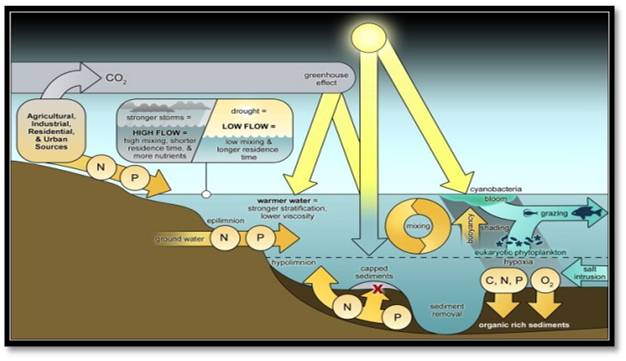
Anthropogenic climate change has recently been identified as a contributing factor to cyanobacterial blooms by altering many environmental conditions that may promote the growth and dominance of HABs. These conditions include:
- Warmer water temperatures
- Changes in salinity
- Increases in atmospheric carbon dioxide concentrations
- Changes in rainfall patterns
- Intensifying of coastal upwelling
- Sea level rise
For more information on the effect of climate change on the occurrence of HABs, please visit the EPA’s Climate Change and Harmful Algal Blooms Fact Sheet (PDF). (3 pp, 172 K, About PDF)
The following conceptual figure illustrates the environmental processes that control cyanobacterial blooms, including man-made management actions and impacts of climate change.
What measures can be taken to prevent cyanobacterial blooms?
Preventative measures are the preferred approach to managing the occurrence of cyanobacterial blooms. The most effective preventative measures are those that seek to control anthropogenic influences that promote blooms such as the leaching and runoff of excess nutrients. Management practices for nutrients, specifically nitrogen and phosphorus, should have the goal of reducing loadings from both point and nonpoint sources, including water treatment discharges, agricultural runoff, and stormwater runoff. Devices that result in the mixing of lakes (for example, by air bubbling), enhance vertical mixing of the phytoplankton, which minimizes the formation of surface blooms of buoyant cyanobacteria. Also, increasing the water flow through lakes or estuaries reduces water residence time and inhibits cyanobacteria blooms; however, these efforts can be expensive and are best suited to small affected water bodies.
Understanding recent blue-green algae advisory in Lake Scugog
Leave a CommentUNDERSTANDING RECENT BLUE-GREEN ALGAE ADVISORY IN LAKE SCUGOG
As a result of questions from the Lake Stewards, Scugog Township, Durham Region Health, and the Ontario Ministry of the Environment and Climate Change (MOECC) have tested the waters adjacent to Palmer Park Beach and Joe Fowler Park, and found the presence of blue-green algae there. The Ministry is currently testing the water to determine whether the blue-green algae bloom is toxic. In the meantime, as a precaution, a public advisory has been issued. To help you understand this advisory better, we have put together a brief FAQ on blue-green algae, and what they mean for the health of Lake Scugog.

WHAT ARE BLUE-GREEN ALGAE?
Blue green algae are not actually true algae, but a group of photosynthesizing bacteria. They are found in virtually every habitat, in freshwater, oceans, even in damp soils. They play a vital role in the health of ecosystems, but can quickly become a problem when they reach high densities (called “blooms”). This is because many species of cyanobacteria are capable of producing toxins. The most commonly reported cyanotoxins are called microcystins, which are a liver toxin as well as a skin, eye, and throat irritant.
WHAT IS A BLOOM AND HOW CAN YOU IDENTIFY IT?
There is no definitive scientific definition of an algal bloom, but it generally means an accumulation of algae that is readily visible with the naked eye. In the case of cyanobacteria, this has to be confirmed by looking at the algae under a microscope to determine which species are present. We are currently confirming with the MOECC what definition they used to define a “bloom” in the recent case of Lake Scugog.
Cyanobacteria blooms usually give the water a blue-green or pea-soup green colour, and commonly (but not always) presents as a slime that accumulates on the surface of the water near shorelines. Cyanobacteria will not be a stringy mass like much of the plant life in Lake Scugog. Although the characteristic colour associated with cyanobacteria is a pea-soup green, blooms of certain species can also appear as olive green or red. Please be aware that, to the untrained eye, it can be easy to confuse surface accumulations of pollen or free-floating macrophytes as a cyanobacteria bloom.
IS THE RECENT REPORTED ALGAL BLOOM IN LAKE SCUGOG TOXIC?
-We do not know yet whether the recent bloom released toxins to the lake at concentrations above water quality guidelines. Testing is ongoing at the MOECC. Until the results are back, it is advisable to avoid swimming or consuming fish caught in the areas included under the advisory. Children or pets should also not play or drink water in these areas until the advisory has been lifted.
WHAT DO I DO IF I SUSPECT A BLOOM ON MY SHORELINE?
We hope our above description helps you to know what to look for. There are also numerous examples on the internet of what a blue-green algae bloom can look like. If you suspect a bloom, the safest thing to do is to assume toxins are present and avoid drinking, bathing, swimming, or otherwise using the water in the vicinity of the suspected bloom. You can report suspected blooms to the MOECC Spills Action Centre at 1-800-268-6060. If possible, take photos of the suspected bloom to share with the MOECC.
WHAT ARE THE STEWARDS DOING ABUT BLUE-GREEN ALGAE IN LAKE SCUGOG?
In addition to acting as a liaison between the community and the township, Kawartha Conservation, Durham Region Health, and the MOECC, the Lake Stewards are also actively supporting ongoing research into algal and plant communities in Lake Scugog by Dr. Andrea Kirkwood’s lab at the University of Ontario Institute of Technology. This research is an important part of our 3-year Ontario Trillium Foundation Grow Grant, which began this summer. We will be sharing the results of our work as we go along, including a series of educational videos produced by Moko Media. We are committed to better understanding cyanobacteria in Lake Scugog, including identifying areas of risk, and the underlying causes of cyanobacteria blooms.
WHAT CAN I DO TO COMBAT BLUE-GREEN ALGAE BLOOMS IN LAKE SCUGOG?
The best thing that you can do to combat cyanobacteria blooms in Lake Scugog is to help manage nutrient run-off into the lake. This includes using phosphate-free detergents, avoiding fertilizer use on lawns (especially those that contain phosphorus), picking up after your dog, and maintaining healthy shorelines and functioning septic systems. Keep an eye out for Kawartha Lakes Blue Canoe program for more information on shoreline management.
We at the Scugog Lake Stewards are always happy to answer questions from the community about the health of the lake, and will continue to serve as your “eyes and ears”.
Dr. Jennifer Korosi , Aquatic Ecologist
Assistant Professor , Department of Geography, York University
Director of Research and Monitoring, Scugog Lake Stewards
General inquiries: Info@scugoglakestewards.ca
Research and Monitoring: research.scugoglakestewards@gmail.com
Barbara Karthein, SLS President: bkarthein@yahoo.ca
Great info. for shoreline owners on Lake Scugog
Leave a CommentAre you looking for a great on-line source of information about how lakes work and specifically Lake Scugog? Look no more. The North American Lake Managers’ Society has published a very easy to read, well illustrated small booklet that we feel you will really find useful called Your-Lake-and-You_July-2017 It may take a bit of time to download, but it is worth it.
We will be using parts from it on our Facebook site over the season. Please contact us if you have questions after reading it and how it applies to our lake.
Lake Scugog, is it a ‘sitting duck’ for new invasives?
Leave a CommentAn article for CAPS magazine, July, 2017. The GTA has a population of 6.5 million with a long shoreline on Lake Ontario. Coming into its docks are ships from around the world bringing two kinds of cargoes, the goods we need and, unfortunately, tiny stowaways from far away. When these stowaways come ashore, they have the potential to cause real damage to our native ecosystem.
Consequently, we now have a parade of invasive aquatic species taking over Lake Scugog. They thrive on the warm water and excess nutrients running off the land. Could we have avoided it, probably not, we are ‘a sitting duck’ so close to our country’s major city.
 Here in Scugog, we have been slow to recognise that washing boats and trailers before and after they enter our lake is the only way to slow down this invasion. We didn’t want to spoil the boaters’ fun and we didn’t have the money to install signs and boat washing areas well away from the lake. We would need big help with that.
All lakes will eventually fill in. The Stewards are trying to do is find out how we can slow down this process and with the fewest possible nasty consequences along the way.
Would you like to do your part? What we know is that it is a mistake to have a mown lawn down to water’s edge. That just makes the problem worse because it removes all of nature’s plant and critter cleaners and allows nutrients and silt to slide off your lawn into the lake. There is no better water cleaner than the lowly cattail.
Fish need a place to spawn. Hatchlings need shelter and food. Shorelines stripped to just grass or even sloped stones with no undergrowth offer nothing to the lake cleaners – the fish, the birds, the turtles.
Personally, learning to landscape for the country meant turning almost every idea I learned when studying Landscape Architecture upside down. For instance, use trees and meadows to Infiltrate rain water into your land, — it is good for your well and the lake. Keep hard surfaces to a minimum as they create more problem runoff into streams and the lake. A buffer strip of native trees, shrubs and plants along the waterfront will bring opportunities for wildlife watching and will keep the lake clean, too. Plant native species because they work best in tandem with all other parts of our eco-system. You will be rewarded with butterflies, birds, turtles and even fish that are the interesting part of country life.
Yes, Lake Scugog has been a sitting duck for years and we have paid the price with horrible invasive plants such as Eurasian watermilfoil, Curly leaf pondweed, the alga Starry stonewort. There are invasive animals, as well, such as zebra mussels and even quagga mussels. But with your help, the Lake Stewards’ lake research, and many more partners, we can prevent the lake from getting worse and from filling in faster. Help us do that by becoming a member at www.scugoglakestewards.com or come to see us at the Craft Brewery Festival, August 12, in Palmer Park.
The Lake Stewards are very pleased to report that they have just received funding from the Federation of Ontario Cottagers (FOCA) to develop and install a Lake Scugog specific sign telling of the supreme importance of pressure washing all areas of boats and trailers both before and after coming to Lake Scugog. We will work with the Ontario Invading Species Council and Kawartha Conservation to develop the boat launch area sign that we would plan to replicate at as many other boat launches around Scugog as we can receive funding to do.